

Item Number: C-0010
Material: Polyester Cotton
Size: 35*70cm, 40*40cm, 30*30cm… Customizable according to customer requirements
Color: Red, Yellow, Blue… Customizable according to Pantone color codes or color samples
Gram Weight: 150-380GSM
Usage: Used for home, kitchen, car, and electronic instrument cleaning
Description and Use:
(1) The towel has high water absorption and a soft feel.
(2) The towel is very durable and easy to clean without detergent.
(3) It contains no chemicals and has no unpleasant odor.
(4) Soft, comfortable, and pleasant to the touch.
(5) Suitable for cleaning various cars, kitchenware, furniture, and pet supplies.
Color: According to customer requirements
Packaging: Standard export packaging or customized packaging according to customer requirements
Origin: Jiangsu, China
Payment Method: Bank Transfer, Alipay, WeChat Pay
Minimum Order Quantity: 2000 pieces
Contact Person:
Ms. Xiao: +86 18906226220 / 15306222870 (WeChat)
Ribbed towels are household textiles made using a ribbed weaving technique. They are typically made from cotton, cotton-polyester blends, or microfiber. By adjusting the warp and weft yarn arrangement, regular raised stripe textures are created. These towels are soft, skin-friendly, absorbent, breathable, durable, and easy to maintain. They are suitable for washing your face, drying hands, bathing, and other everyday home uses, combining practicality with simple decorative appeal. The following systematically presents the product information from basic definition, core features, materials and technology, specifications, care instructions, and purchasing guidance.
Ribbed towels are fabrics woven by adjusting the warp and weft feed rates, density, and arrangement, creating continuous and regular raised stripe textures on the towel surface. Unlike standard plain towels, the ribbed process produces three-dimensional stripes through yarn density differences. Stripe width typically ranges from 0.5–2 cm with uniform spacing. This enhances tactile layers and improves absorbency and breathability. Shapes include face towels, bath towels, and hand towels.
The ribbed weaving principle is warp-weft differential arrangement: during weaving, certain areas increase weft density or adjust warp tension to create raised stripes, while adjacent areas reduce yarn density or loosen tension to form recessed grooves. This structure increases surface area contact between fibers and water, improving absorbency efficiency.
| Material Type | Composition | Key Advantages | Limitations | Suitable Use |
|---|---|---|---|---|
| 100% Cotton Ribbed Towel | Combed cotton/long-staple cotton (mainly 21–32 yarns) | Soft, breathable, skin-friendly, highly absorbent; suitable for sensitive skin | Slower drying; can stiffen with long-term use | Face washing, bathing, infant use |
| Cotton-Polyester Blend Ribbed Towel | Cotton 60–80% + Polyester 20–40% | Durable, maintains shape, high colorfastness, easy to clean | Slightly less breathable than pure cotton | Hand drying, kitchen, dormitory use |
| Microfiber Ribbed Towel | Polyester-Nylon blend (Polyester 70% + Nylon 30%) | Fast absorption (3–5× its own weight), quick-drying, antibacterial | Slightly slippery, less skin-friendly than cotton | Sports sweat wiping, car cleaning, home cleaning |
| Bamboo Fiber Ribbed Towel | Natural bamboo fiber (or bamboo-cotton blend) | Naturally antibacterial, odor-resistant, breathable | Less durable, higher price | Summer face washing, sensitive skin care |
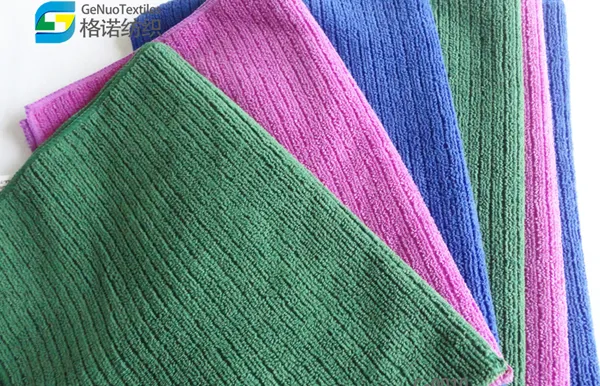
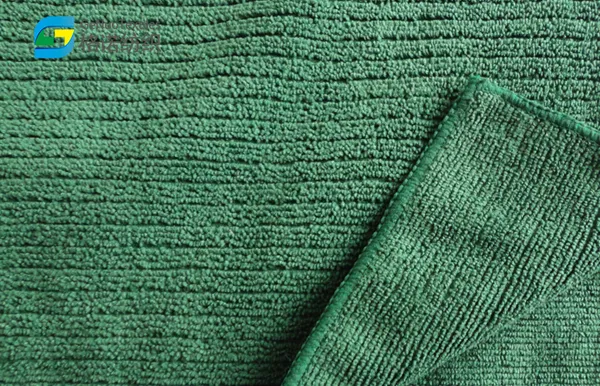
Stripe Pattern: Commonly horizontal or vertical rib stripes. Horizontal stripes suit face towels and hand towels, improving comfort during use; vertical stripes suit bath towels, enhancing grip when wrapping. Stripe width: narrow (0.5–1 cm) for finer feel, wide (1–2 cm) for better absorbency and breathability.
Loop Structure: Raised stripe areas have dense, fluffy loops; recessed areas are sparser. This “dense-sparse combination” ensures absorbency while reducing towel weight and improving portability.
Edge Treatment: Hemmed or satin-edge finishing enhances durability or aesthetic appeal. Hemmed edges are stronger for frequent use; satin edges allow simple printed patterns for decorative purposes.
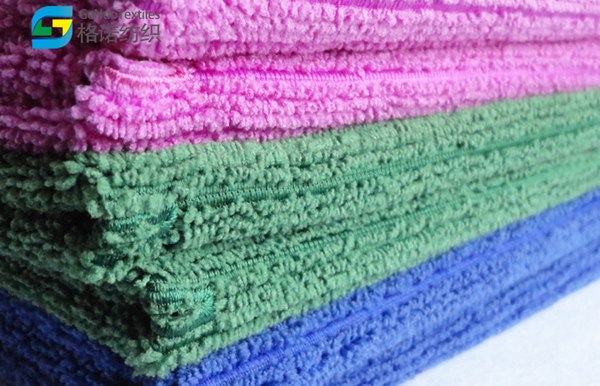
Ribbed textures increase surface area. Dense loops on raised stripes quickly absorb water, while recessed stripes allow airflow, accelerating evaporation. Cotton ribbed towels absorb water faster than standard cotton towels. Microfiber ribbed towels dry 30–50% faster, suitable for humid or high-frequency use environments.
Combed cotton ribbed towels remove short fibers and impurities for a soft, smooth touch, suitable for infants and sensitive skin. Cotton-polyester blends enhance resistance to stretching and pilling; shape remains stable after multiple washes.
Ribbed surfaces resist hiding dirt, making stains easy to remove. Cotton towels can be machine or hand washed. Cotton-polyester and Microfiber Towels support high-temperature washing for better sterilization. After washing, hang to dry in a ventilated area.
Regular stripes provide a simple, modern look that suits Scandinavian or minimalist decor. Multi-color options allow easy household member differentiation and enhance hygiene.
| Product Type | Standard Size (L×W, cm) | GSM (g/m²) | Stripe Width (cm) |
|---|---|---|---|
| Face Towel | 34×75, 35×70 | 200–300 | 0.5–1 |
| Bath Towel | 70×140, 75×150 | 300–400 | 1–2 |
| Hand Towel | 30×30, 40×40 | 150–250 | 0.5–1 |
| Sports Towel | 100×30, 120×35 | 200–280 | 0.8–1.5 |
Safety: Complies with GB 18401 (Class A for infants, Class B for adults). No formaldehyde, optical brighteners, or heavy metals.
Performance: Colorfastness ≥3; pure cotton face towel should absorb ≥80% water in 10 seconds; tensile strength remains stable after multiple washes; loop retention ≥90%.
Raw Material Preparation: Use combed or long-staple cotton yarns, carded and twisted for uniformity and strength.
Rib Weaving: Warp yarns divided into base and pile yarns. Pile yarns feed variably to form raised stripes. Weft yarns interlace to create recessed grooves, controlling tension for even stripe spacing.
Dyeing and Finishing: Reactive dyeing ensures uniform color and high colorfastness. Pre-shrinkage reduces shrinkage to 3–5%. Softening treatment enhances texture.
Cutting and Sewing: Cut to specification, hem or satin-edge finished, inspect loop integrity and stripe evenness, discard defective pieces.
Tension Control: Maintain uniform pile height; differential weft density must be stable.
Dyeing Control: Ensure no color variation in stripes; infant towels require eco-friendly, fluorescent-free dyes.
Finishing Control: Softener dosage balanced to avoid blocking fiber pores and reducing absorbency; pre-shrinkage ensures size stability.

Separate Use: Designate towels by function (face, hand, bath) to prevent cross-contamination; infants should have dedicated towels.
Pre-Use Treatment: Wash 1–2 times to remove loose fibers and residual dye.
Applicable Scenarios: Cotton for daily washing and bathing, microfiber for sports and cleaning, bamboo fiber for summer or antibacterial needs.
| Material | Cleaning Method | Care Tips | Notes |
|---|---|---|---|
| Cotton | Machine/hand wash ≤40°C, neutral detergent | Hang to dry, avoid direct sunlight, gently fluff | No bleach or softener |
| Cotton-Polyester | Machine wash ≤50°C | Low-temp tumble dry, reshape stripes | Avoid prolonged soaking |
| Microfiber | Hand/machine wash ≤30°C, neutral detergent | Hang to dry, avoid high heat | No softener |
| Bamboo | Hand wash ≤30°C | Air dry, avoid sunlight | Avoid rough clothing |
Cotton: replace every 2–3 months or sooner if loops shed or absorbency decreases.
Cotton-polyester/microfiber: 3–6 months; replace if damaged or deformed.
Infant towels: monthly replacement recommended.
Prefer combed cotton or long-staple cotton for softness and absorbency.
Microfiber suitable for sports or home cleaning.
Bamboo fiber for summer use or antibacterial requirements.
Stripe Appearance: Even, dense raised loops, aligned patterns.
Edge Integrity: Hem or satin-edge smooth and secure.
Feel Test: No roughness, loops intact, minimal shedding.
Check label for GB 18401 compliance and yarn specification.
Test absorbency: cotton towels should absorb water instantly.
Ensure no strong odor; avoid fluorescent agents.
Home Use: Face washing, hand drying, bathing.
Mother & Baby: Soft cotton towels for infants.
Sports & Fitness: Microfiber Towels for sweat wiping.
Hotels & Lodging: Durable cotton-polyester towels for bulk use.
Eco-Friendly: Organic cotton, recycled fibers, waterless dyeing.
Functional Integration: Antibacterial, cooling, mite-resistant additives.
Design Personalization: Embroidery, jacquard, and custom stripe patterns.
Size Customization: Mini hand towels or oversized bath towels for different scenarios.
This website uses cookies to ensure you get the best experience on our website.
 Español
 Portugues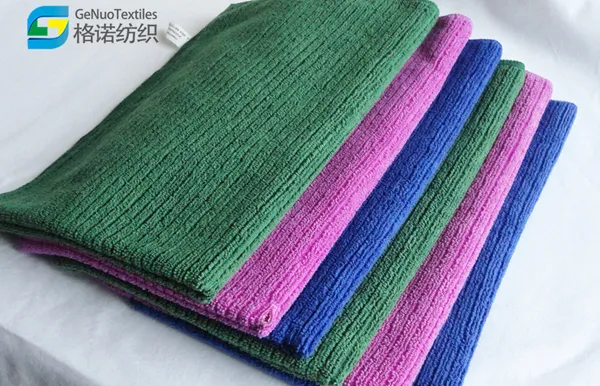





 Phone
Phone